Sound is rarely neutral. A single chord shift can make an audience hold its breath; a bass drop can transform a stadium into one collective heartbeat. Across entertainment — from the opening frame of a blockbuster to the final whistle of a championship match — music is doing structural work that most people never consciously register. It anchors attention, modulates emotion, and shapes memory in ways that visuals and narrative alone cannot.
The Architecture of Film Scores
Contemporary film scoring is built on the principle of leitmotif — assigning recurring musical themes to specific characters or emotional states. Composers like Hans Zimmer and John Williams have constructed entire franchise soundscapes on this foundation. The Imperial March from Star Wars and the two-note motif from Jaws are not decorative choices; they are narrative architecture. According to research published in Psychology of Music, musical cues significantly affect viewers' interpretation of ambiguous scenes, steering emotional readings that the image alone leaves open.
Bernard Herrmann's work for Hitchcock remains a textbook case. Psycho's shower scene is routinely described as inconceivable without its strings — Herrmann himself framed the music not as accompaniment to the murder, but as the sound of it. The Academy of Motion Picture Arts and Sciences recognises Original Score as a distinct category for exactly this reason: a great score does not accompany a film; it completes it.
Music in Video Games: When Sound Becomes Interactive
Video game audio is among the most technically complex applications of music in any medium. Unlike cinema, games are non-linear — the player controls pace and duration, which demands adaptive composition: scores that respond dynamically to player behaviour in real time.
The Game Audio Network Guild has tracked the field's evolution from 8-bit chip tunes to full orchestral recordings at Abbey Road. Nintendo's The Legend of Zelda series uses layered audio stems that add or remove instruments depending on proximity to enemies or narrative triggers. The player rarely notices the music shifting — but they feel it. Tension builds, relief releases. The score functions as invisible scaffolding.
Online gaming environments have adopted the same logic. Casino platforms use curated audio to regulate tempo and mood. For players navigating these digital spaces, the full experience matters — from atmosphere to interface to payment. Resources like https://betpokies.co.nz/casinos/poli, which guides New Zealand players through the POLi payment method, reflect the same demand for intuitive, frictionless design that makes good audio so valuable: when the environment feels smooth and coherent, the experience itself comes forward. Platforms that cover music and digital culture, including notjustok.com, have increasingly documented how African artists are entering the game audio space — composers from Lagos and Nairobi contributing original work to global releases and streaming-native content.
Sound at Live Events: Sport, Spectacle, and Shared Feeling
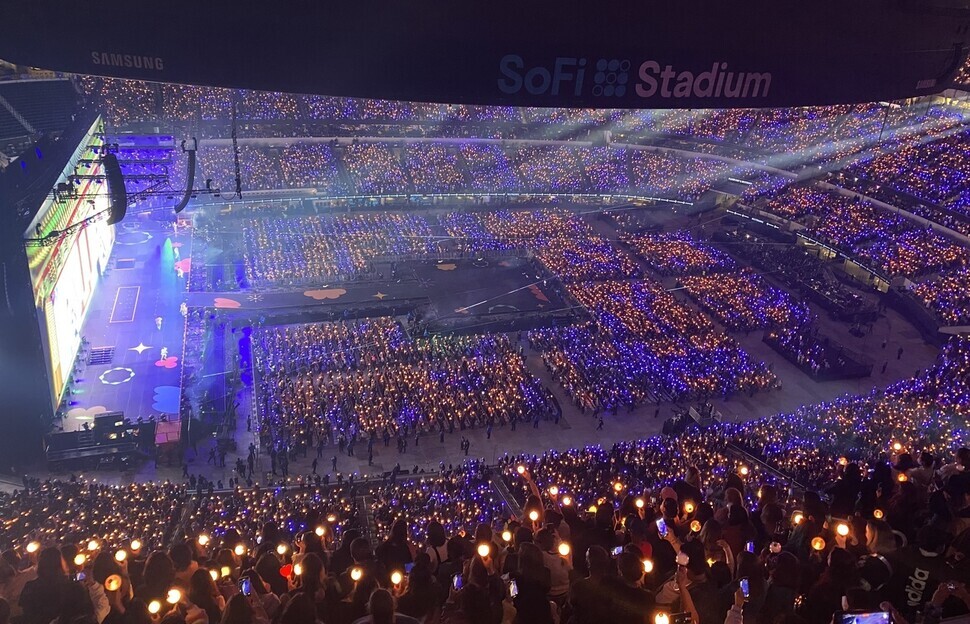
Few settings make music's power more visceral than live sport. UEFA's Champions League anthem — composed by Tony Britten and recorded by the Academy of St Martin in the Fields — has become one of the most globally recognised pieces of event music ever produced. Its function is explicitly ceremonial: it marks the transition from ordinary life into the ritual space of competition.
At the club level, stadium music operates as community infrastructure. Liverpool's "You'll Never Walk Alone" and Arsenal's early-2000s adoption of "Is This the Way to Amarillo" show how songs become inseparable from institutional identity. The same phenomenon operates at the Olympic Games, where Thomas Bangalter's Ceremony for Paris 2024 drew critical attention for scoring national identity for a global audience, referencing French musical traditions without collapsing into any single genre.
Sports broadcasters understand that music controls narrative pacing. The BBC's Match of the Day theme — composed by Barry Stoller — is one of British broadcasting's most recognisable pieces of incidental music, not for its compositional complexity but for its conditioning: for millions of viewers, it reliably signals the weekend ritual of watching.
Key Ways Music Shapes the Entertainment Experience
The mechanisms through which music exerts influence across these formats can be grouped into six distinct functions:
- Emotional priming — music heard before or during an event shapes how audiences interpret what follows. Research from the University of California, Davis shows that identical film clips rated characters as significantly more threatening under dissonant music than under consonant music.
- Memory consolidation — musical themes act as retrieval cues. A Champions League anthem heard years later involuntarily resurfaces associated memories and feelings.
- Temporal regulation — tempo controls perceived pace. Fast music compresses time; slow music extends it. Broadcasters and game designers exploit this to deliberately manage audience energy.
- Illing — music communicates affiliation. Franchises and stadiums use audio to tell audiences who they are and who they are with.
- Immersion deepening — adaptive scores in interactive media reduce the cognitive distance between the player and the world, generating flow states: the condition of full absorption in an activity.
- Transition marking — music signals contextual shifts, from advertising to broadcast, from warm-up to match, from lobby to gameplay. These transitions are structurally necessary in live and interactive formats.
Coverage of these dynamics, including how African popular music fits into them, appears regularly on platforms like notjustok.com, where Afrobeats, Amapiano, and their commercial trajectories are tracked in detail.
How Music Powers Games, Films, and Live Events
Music powers games, films, and live events because it performs work no other production element can replicate: it operates beneath conscious attention, directly modulating arousal, directing emotional interpretation, marking time, consolidating memory, and binding audiences into shared experience. Remove the score from a sports broadcast, and you lose ceremony and rhythm. Remove it from a film, and you have a record of events rather than an experience. Remove adaptive audio from a game, and the illusion of a responsive world collapses. In each case, music is not layered onto the entertainment — it is constitutive of what makes the entertainment feel like more than the sum of its parts.
Get latest in Betting world here, and Follow Notjustok on X and Facebook. Read the Notjustok's Affiliate disclaimer